Tampilkan postingan dengan label history. Tampilkan semua postingan

the 3 mile perfect circle of Corona (is that the origin of Perfect Circle piston rings?)


then and now...


Thansk Steve!

Imagine an America where races took place on public roads, before street signs, before highway patrol and patrol cruisers, before speed limits.

It'll never happen again. 

"Where they raced" dvd just came out, here are a couple of clips


WHERE THEY RACED: Speed Demons in the City of Angels tells the story of a pre-gridlocked Los Angeles... a time ripe with orange groves, movie stars, year-round sunshine and more auto racing and innovation than anywhere else in the world. This documentary film is told with hundreds of vintage photos, lost archival films and revealing interviews that reunite the ghost tracks of Los Angeles with the cars that raced on them to give these fading memories a victory lap.

You will not find a more complete perspective on the historic Southern California racing scene. - AUTOWEEK

Winner - Motor Press Guild Best of the Year 2013 - Motor Press Guild

The film includes:
•Visit all 3 of Los Angeles’ boardtracks, we had the first, the best and the fastest
•Lakes, Parks & Rods with Wally’s son on the Pomona Drag
•Vic Edelbrock Jr. brings Roger Ward’s V8-60 back to Gilmore
• Ultimate barn find: a Peugeot that influenced Miller, Offy and decades of racing
•Ed Winfield’s #1 Ford is reunited with the remains of Legion Ascot & takes a lap
•Join Mickey Thompson’s son & first wife for a 1/4 mile walk down memory lane
•Eddie Pullen’s son, a ‘13 Fiat & a ‘11 National relive the Santa Monica Road Races
• Greg Sharp at NHRA & Leslie Kendall at the Petersen
•414 mph Land Speed Record holder Charles Nearburg shows off his 1926 Miller
•JC Agajanian Jr. talks Turkey Night
•Huell Howser sees something “Amazing” at the Corona Circle
•And much more in almost 2 hours of racing history

two screenings at:
Feb 9th at Automobile Driving Museum 2/9 @1PM
Feb. 26th at Petersen Automotive Museum 2/26 @ 7PM

the DVD is $25 and can be purchased at http://www.wheretheyraced.com/WHERE_THEY_RACED/Where_They_Raced.html

Cuban Missile Crisis, 1962, Florida coast


During the Cuban Missile Crisis, U.S. Army anti-aircraft rockets sit, mounted on launchers and pointed out over the Florida Straits in Key West, Florida, on October 27, 1962. (AP photo)

found on http://pixtale.net/2012/05/50-years-ago-the-world-in-1962/

the reason the USA takes the day of, calls it Labor Day, is to remind employees of those that went through hell to get legal rights for employee safety, many died in massacres to get you these rights, take a moment to ponder that. Then have a cold drink because they died so you could do so without a club at your head


Woodie Guthrie, American folk song legend


Woody Guthrie sings about the Ludlow Massacre, in which 20 people were killed for striking against coal mine operators in 1914. Happy Labor Day! Enjoy your day off, but give a thought to organized labor, which is what this day is all about.

The first Labor Day was held in 1882. Its origins stem from the desire of the Central Labor Union to create a holiday for workers. It became a federal holiday in 1894. It was originally intended that the day would be filled with a street parade to allow the public to appreciate the work of the trade and labor organizations. After the parade, a festival was to be held to amuse local workers and their families.

Ten demonstrators were killed by police bullets during the "Little Steel Strike" of 1937. When several smaller steelmakers, including Republic Steel, refused to follow the lead of U.S. Steel (Big Steel) by signing a union contract, a strike was called by the Steel Workers Organizing Committee (SWOC) of the Congress of Industrial Organizations (CIO). As a show of support, hundreds of SWOC sympathizers from all around Chicago gathered on Memorial Day at Sam's Place, where the SWOC had its strike headquarters. After a round of speeches, the crowd began a march across the prairie and toward the Republic Steel mill.

They were stopped midway by a formation of Chicago police. While demonstrators in front were arguing for their right to proceed, police fired into the crowd and pursued the people as they fled. Mollie West, a Typographical Union Local 16 member and a youthful demonstrator at the time, still recalls the command addressed to her: "Get off the field, or I'll put a bullet in your back."
http://www.illinoislaborhistory.org/memorial-day-massacre.html

Despite the filmed violence, SWOC lost the strike. Continued violence combined with financial pressures to force the workers back in without a contract. Yet time was on the steelworkers side. Some of the companies signed contracts in 1938. In 1942, President Franklin Roosevelt, not wanting any labor issues during the war, put major pressure on the Little Steel companies through the National War Labor Board to recognize SWOC as the legitimate bargaining agent for their workers, which finally forced Girlder and the other steel magnates to cave. http://www.lawyersgunsmoneyblog.com/2012/05/this-day-in-labor-history-may-30-1937

and that pretty much sums up why the governments and police departments of all nations don't want the citizens to have guns, and why it's important for the citizens to have guns... and ammo

the Ford Massacre was a demonstration of unemployed workers starting in Detroit and ending in Dearborn, Michigan, that took place on March 7, 1932.
The march resulted in four workers being shot to death by the Dearborn Police Department and security guards employed by the Ford Motor Company. Over 60 workers were injured, many by gunshot wounds. Three months later, a fifth worker died of his injuries. The march was organized by the Unemployed Councils. The Ford Hunger March was an important part of a chain of events that eventually led to the unionization of the U.S. auto industry.

All of the seriously wounded marchers were arrested, and many were chained to their hospital beds. That night, the offices of many Communist and Communist front organizations were raided in the Detroit area, and their leaders were arrested.  No law enforcement or Ford security officers were arrested, although all reliable reports showed that they were responsible for all of the gunfire.  http://en.wikipedia.org/wiki/Ford_Hunger_March

Cannery Workers murdered due to manufacturing owners: http://depts.washington.edu/depress/cannery_workers_union_murders.shtml
Patron, the nephew of a labor contractor, murdered the two men due to their involvement in union efforts to remove the contracting system from the salmon canning industry.

Everyone from carpenters and street car conductors to waitresses and newsboys belonged to a union. In 1919, when Seattle unions gained worldwide headlines by declaring a general strike that shut down the city for five days, some 60,000 workers belonged to 110 unions affiliated with the Seattle Central Labor Council and the Washington State Federation of Labor. http://depts.washington.edu/depress/strikes_unions.shtml

23 November 1903 (United States) Colorado Labor Wars -- Troops were dispatched to Cripple Creek, Colorado to defeat a strike by the Western Federation of Miners, with the specific purpose of driving the union out of the district. The strike had begun in the ore mills earlier in 1903, and then spread to the mines.
8 June 1904 (United States) A battle between the Colorado Militia and striking miners at Dunnville ended with six union members dead and 15 taken prisoner. Seventy-nine of the strikers were deported to Kansas two days later.

19 August 1916 (United States) Strikebreakers hired by the Everett Mills owner Neil Jamison attacked and beat picketing strikers in Everett, Washington. Local police watched and refused to intervene, claiming that the waterfront where the incident took place was Federal land and therefore outside their jurisdiction. (When the picketers retaliated against the strikebreakers that evening, the local police intervened, claiming that they had crossed the line of jurisdiction.) Three days later, twenty-two union men attempted to speak out at a local crossroads, but each was arrested; arrests and beatings of strikebreakers became common throughout the following months, and on 30 October vigilantes forced IWW speakers to run the gauntlet, subjecting them to whipping, tripping kicking, and impalement against a spiked cattle guard at the end of the gauntlet. In response, the IWW called for a meeting on 5 November. When the union men arrived, they were fired on; seven people were killed, 50 were wounded, and an indeterminate number wound up missing.

26 August 1919 (United States) United Mine Worker organizer Fannie Sellins was gunned down by company guards in Brackenridge, Pennsylvania.

 22 September 1919 – 8 January 1920 (United States) The "Great Steel Strike" began. Ultimately, 350,000 steel workers walked off their jobs to demand union recognition. The AFL Iron and Steel Organizing Committee called off the strike on 8 January 1920, their goals unmet.

11 November 1919 (United States) Centralia Massacre -- IWW organizer Wesley Everest was lynched after a Centralia, Washington IWW hall was attacked by Legionnaires.

22 December 1919 (United States) Amid a strike for union recognition by 395,000 steelworkers (ultimately unsuccessful), approximately 250 "anarchists," "communists," and "labor agitators" were deported to Russia, marking the beginning of the so-called "Red Scare."

19 May 1920 (United States) The Battle of Matewan.
 Despite efforts by police chief (and former miner) Sid Hatfield and Mayor Cabel Testerman to protect miners from interference in their union drive in Matewan, West Virginia, Baldwin-Felts detectives hired by the local mining company arrived to evict miners and their families from the Stone Mountain Mine camp. A gun battle ensued, resulting in the deaths of 7 detectives, Mayor Testerman, and 2 miners.

 Baldwin-Felts detectives assassinated(Police Chief) Sid Hatfield 15 months later, sparking off an armed rebellion of 10,000 West Virginia coal miners at the "Battle of Blair Mountain," dubbed the "redneck war" and "the largest insurrection this country has had since the Civil War." Army troops later intervened against the striking mineworkers in West Virginia.

22 June 1922 (United States) Herrin massacre-- Thirty-six people are killed, 21 of them non-union miners, during a coal-mine strike at Herrin, Illinois.


the 1934 San Francisco general strike on the waterfront, the national guard were called in, with tanks :
http://justacarguy.blogspot.com/2011/06/1934-moment-in-labor-vs-employers.html

These scare tactics led to an investigation of employer actions by a Senate subcommittee. The flagrant destruction of many of the records of the Industrial Association, described in this report, effectively prevented the Committee from obtaining full documentary evidence on the activities of the association. Violations of Free Speech and Rights of Labor, the subcommittee’s 1942 report, described the concerted efforts of the Industrial Association, the newspapers, and the San Francisco police to discredit the strike.

 http://historymatters.gmu.edu/d/5134 for the entire report

 Didn't see that in your American History book did you. Just one case in a long history of corporate greed versus workers and unions, and just one example of the people with the money doing anything at all to make more money and the people with power abusing it. Both the money and the power calling the shots and forcing the cops and national guard to shoot the strikers. No kidding. Photos from http://www.johngutmann.org/

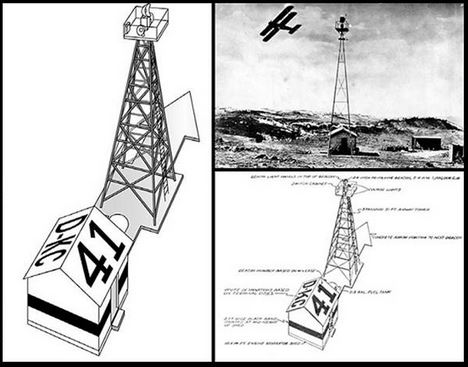
the truth is often stranger than fiction, and forgotten in months after its out of the news.. here is something I've never learned of or heard of, the airmail transcontinental route markers


A couple months ago I learned about the elevated bicycling wood road from Pasadena to Los Angeles, http://justacarguy.blogspot.com/2013/07/forgotten-history-of-what-might-have.html and today Randy sent me an email about these large concrete markers that the airmail pilots used to stay on course from New York to San Fransisco, before electronic stuff like radar and radio direction finding, when all a pilot had was a compass and a map... and those weren't so great to use while airborne.

So these concrete arrows were made, painted yellow for daylight visibility, and lit with enormous light towers at night


the two maps below indicate the airfields used for refueling and food stops, not the arrows.


sources of these images and more info: http://introductiontoflying.blogspot.com/2011/08/transcontinental-air-mail-route.html
and Conde Nast Traveler http://www.cntraveler.com/daily-traveler/2013/06/transcontinental-air-mail-route-maphead-ken-jennings

I just learned of this past weekends Model A event, the Texas Tour


these top two photos are courtesy of Robert


these last two photos are of the wagon ruts in a limestone riverbed from the pioneer days, from the 5 page gallery of the event at http://www.soonermodela.org/apps/photos/album?albumid=14832804

Hungarian made cars, the difficult struggle against political turmoil, lack of manufacturing, and frequent bureaucratic red tape... all they want is to build cars!

Hungarian car enthusiasts Pal Negyesi and Csaba Hajdu have researched the Hungarian car history thoroughly, and made a 35 page PDF that exemplifies the spirit of perseverance to surmount obstacles in the way of progress.

Their focus is the Hungarian cars made between the years 1945 - 1990, but the inventors, craftsman, and innovators often began before 1945... and so did the national and intenational conflicts and restrictions that created a one of a kind unique situation that resulted in the USSR organization COMECON ruling of 1949 that of all the allied countries, only Hungary would not be allowed to build cars. Busses and trucks, yes... but not cars that the people could use for personal enjoyment, business travel, and product distribution (flowers, parcel delivery, etc etc)

Just as important as the automobile enthusiasts informative look, is the historian enthusiasts understanding of the myriad problems that were brought about by WW2, the USSR governing bureaucracy regulations, lack of car parts manufacturing (no car tire makers for example led to using airplane tail tires), political refusal to allow foreign investors, the revolution of 1956, the oil crisis of 1973, the fall of the USSR in 1990 dissolving all the previous infrastructure that was just beginning to make progress in loosening govt owned company restrictions in involvement in cooperative ventures to produce car and parts... all complicated the Hungarian auto enthusiasts ability to make cars.

But read about the many one off cars that were prototyped, microcars that were made and attempted during this time, the 3 wheelers that were declared "motorbike and sidecar" etc etc in order to bring mobility to the people.


Price is EUR 1 or USD 1.4

There are two ways to pay:

- Either someone sends the amount via PayPal to npaul@hu.inter.net and then Pal will send him/her the link
- You can buy an e-book version at Amazon: http://www.amazon.com/dp/B005LOVR02

Major road photography collection saved from the city dump, right out of the dumpster, and will now be scanned and available online to the public (includes first mile of concrete road, first snowmobile, first modern traffic light)


Thanks to Nancy Darga, Managing Director of MotorCities National Heritage Area; these photographs and documents were rescued from a dumpster during the turmoil days of reorganizing Wayne County in the 1980's. They were turned over to the State to be protected in a climate control facility with appropriate archival treatment. Mark Harvey, the Director of Collections and Education of the Historical Museum, said " We are happy to be able to preserve these valuable photos and documents and make them available to the public for the first time".

Nancy Darga, stated that "saving these artifacts is just the first step in preserving our heritage. We are working with the Michigan Historical Museum to scan these documents for public viewing. It is time to bring attention to Wayne County's innovations that led to the first mile of concrete, the first modern traffic light, the first snow plow, the first depressed limited access freeway and the painted white line that delineates lanes that saves lives daily".

A big hug of gratitude to Nancy for saving photos from oblivion, and kick starting a program to scan and make them available to the online public!

1934, the all the west coast longshoremen, teamsters, and seamen unions went on strike and the national guard was called in


The nationwide labor upsurge of 1934 reached its peak in San Francisco. On May 9, 1934, leaders of the International Longshoremen’s Association (ILA) called a strike of all West Coast dockworkers, demanding a wage scale of the 6-day, 30-hour week at a minimum rate of $1 per hour, a “closed shop” (union membership as a requirement of employment), and union-administered hiring halls.

On May 15 teamsters, boilermakers and machinists voted a sympathy strike along with sailors and marine firemen’s union, involving 4,000 men, and 700 marine cooks and stewards took similar action the next day. Ferry boatmen, masters, mates and pilots, and marine engineers first struck against several companies for higher wages and a closed-shop contract, and subsequently the entire local was called out in a body. Not a single freighter left a Pacific coast port “for the first time in history.”

Enraged employers, backed by a sympathetic mayor and police chief, used every means available to open the waterfront and protect strikebreakers, whom they imported in large numbers. Working closely with local politicians and the press, the employers set out to convince the public that the strike was controlled by “Reds” intent on overthrowing the government.

These scare tactics led to an investigation of employer actions by a Senate subcommittee. The flagrant destruction of many of the records of the Industrial Association, described in this report, effectively prevented the Committee from obtaining full documentary evidence on the activities of the association. Violations of Free Speech and Rights of Labor, the subcommittee’s 1942 report, described the concerted efforts of the Industrial Association, the newspapers, and the San Francisco police to discredit the strike.

http://historymatters.gmu.edu/d/5134/ for the entire report

Didn't see that in your American History book did you. Just one case in a long history of corporate greed versus workers and unions, and just one example of the people with the money fdoing anything at all to make more money and the people with power abusing it. Both the money and the power calling the shots and forcing the cops and national guard to shoot the strikers. No kidding.
Photos from http://www.johngutmann.org/

A deep south speedtrap so bad, it was national news, and the state govenor had warning signs installed on the town limits, Ludowici Georgia

TWO large roadside billboards just inside the county lines north and south of town used to guard the approach to Ludowici. Placed there by Governor Lester Maddox, they warned approaching motorists of "speed traps" and "clip joints" in large black letters on a white background

The county seat, and location of all three of the county's newspapers. It was also one of the best-known little nowheres in the country. Sitting astride the junction of federal highways 301, 25 and 82, Ludowici commanded the traditional north-south highway to Florida; 1,000,000 motorists drive through town each year. But in 1975 the Interstate 95 diverted traffic around it.

During the '50s it became known as the site of a treacherous stop light that trapped motorists by changing from green to red without warning, after which the travelers were ticketed by a waiting policeman. Since 1960 when the light was replaced, Ludowici's speed traps have bilked motorists of a rumored $100,000 annually. Said Governor Maddox: "The place is lousy, rotten, corrupt, nasty and no good."

Ludowici has nevertheless defied the efforts of three Governors to shut down the speed traps. For years some of the local gas stations also conducted a profitable con game. When an unsuspecting motorist stopped to have his oil checked, the attendant would disable the car by tinkering with the generator or pouring water in the crankcase oil, then suggest that the customer move his crippled vehicle to a nearby garage for repair. Fittingly enough, the repair shop was called "Billy Swindel's."

The man behind the speed trap, and behind everything else in Ludowici, was the county's colorful political boss, Ralph Dawson, a back-country lawyer who ran Long County since 1932, he headed a political machine that never lost an election at the county or city level.

from a Time magazine article in 1970
http://www.time.com/time/magazine/article/0,9171,909123,00.html
 

Blogger Template